• Home
  • Posts RSS
  • Comments RSS
  • Edit
Blue Orange Green Pink Purple

Still under construction ;)

-------------------------------------

It's Official: Google Now Counts Site Speed As A Ranking Factor

Google has kept a promise it made last year: Site speed is now a ranking factor in Google’s algorithm, and is already in place for U.S. searchers. But Google also cautions web site owners not to sacrifice relevance in the name of faster web pages, and even says this new ranking factor will impact very few queries. More on that below, but first the background on today’s announcement from Google Fellow Amit Singhal and Matt Cutts, head of Google’s web spam team.

Why Page Speed Matters

The first warning that site speed was on Google’s radar came last November, when Cutts said there was “strong lobbying” inside Google to account for site speed as a new ranking factor. Speaking at SMX West last month, Google’s Maile Ohye showed a slide indicating that delays of under a half-second impact business metrics.


In addition to the numerous studies over the years that show Internet users prefer fast pages, Singhal says Google ran its own testing on how users respond to page speed, including experiments on Google.com. Singhal and Cutts point to a June 2009 blog post on the Google Research Blog that talked about how Google purposely slowed down its search results to measure the impact on search behavior.

Our experiments demonstrate that slowing down the search results page by 100 to 400 milliseconds has a measurable impact on the number of searches per user of -0.2% to -0.6% (averaged over four or six weeks depending on the experiment). That’s 0.2% to 0.6% fewer searches for changes under half a second!

“When we slow our own users down [on Google.com], we see less engagement,” Singhal says. “Users love fast sites. A faster web is a good thing all around.”

How Google Measures Page Speed

Singhal says there are two primary ways Google will measure page speed:

How a page responds to Googlebot
Load time as measured by the Google Toolbar
In December, Google added a page speed report to Webmasters Tools in the “Labs” section. The report shows how fast your site loads, specifically calls out several pages on your site, and offers suggestions to improve page speed.


Where Page Speed Fits in Google’s Algorithm

Google’s algorithm has about 200 different ranking factors, and even though Google is taking the unusual step of publicly announcing a new factor, Cutts says site owners shouldn’t overestimate the impact of page speed on rankings.

“Quality should still be the first and foremost concern [for site owners],” Cutts says. “This change affects outliers; we estimate that fewer than 1% of queries will be impacted. If you’re the best resource, you’ll probably still come up.”

Singhal says the focus remains on improving the user experience on Google.com, and the company can’t do that if it gets the relevance of search results wrong. “We want to return faster sites,” he says, “but not at the expense of relevance.”

Final Thoughts

Page speed is in place now as a ranking factor on Google.com, and has been for a couple weeks. If your site was going to be impacted, it probably would’ve happened already. Google plans to monitor the results of this change and eventually expand the use of page speed as a ranking factor in other countries.

One last note: Google says this ranking change has no relation to its upcoming Caffeine rollout, which is about how Google indexes the web, not how it ranks pages.

From: http://searchengineland.com/google-now-counts-site-speed-as-ranking-factor-39708
Read More View Comments | Posted by Fotis edit post

Context is King: How Videos Are Found And Consumed Online

YouTube, LLCImage via Wikipedia

To try to understand—let alone guess—the future of video advertising, one needs to start by looking at the biggest trend in media over the past few decades.  In November 2006, Bear Stearns Cable and Satellite analyst Spencer Wang published a study called “Why Aggregation & Context and Not (Necessarily) Content are King in Entertainment”.  While Bear Stearns has since been acquired by JP Morgan and is now a mere footnote in business books, the study’s findings are more relevant than ever.  Let’s examine 8 key factors behind online video consumption
Factor 1: Media is Fragmenting

According to a recent NY Times article, in the 1952-53 season, more than 30% of American households watched NBCduring prime time, according to Nielsen.  In fact, up until twenty years ago, you could buy a 30-second spot on CBS, NBC or ABC and reach “everyone.”  Today, NBC’s prime time reach is 5%.  Sure, NBC is lagging CBS and ABC, but neither the Tiffany network nor Disney’s counterpart is faring much better.  The secret’s out: fewer people watch TV and teenagers spend every waking minute connected to the Internet, increasingly through the mobile web.
Factor 2: Deportalization is Here to Stay
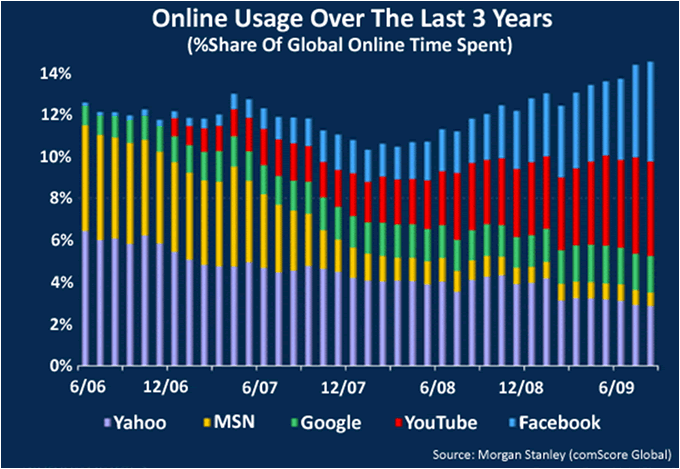
As the media world becomes fragmented and consumers move online, the Web is following a similar path, known as deportalization: the move away from the dominant portals of old, as social networks gain huge followings and vertical niche sites gain smaller, but more loyal, followings.
Ten years ago, you could buy a banner on MSN, AOL or Yahoo and reach “everyone” on the Web.  Five years ago, you could get the same result by buying a text link through AdWords and reach consumers who were either searching directly on Google.com, or surfing on the countless number of websites that were part of Google’s publisher network through AdSense.

Suffice to say, times have changed.  In fact, less and less often do consumers even seek out content  by actually going to a given site.  To paraphrase Jeff Jarvis, if something is important, it will find me, be it via newsletter,Facebook, Twitter or a shared link in an email.  In fact, Facebook might very well be the last giant Web property and when it launched Facebook Connect, it too began to extend its tentacles across the Web.  Twitter’s growth hasmaintained thanks to its off-site (API) growth, while YouTube exploded due to its open embeddable nature from the get-go.
However, after YouTube sold to Google for $1.65 billion and the site’s aggregate traffic soared, some video producers tried to find a way to generate an audience—and revenues—outside of YouTube in order to build a legitimate business.  In other words, media is becoming fragmented, the Web is becoming deportalized, and the front line of it all is online video.
Factor 3: Content is Not a Zero-Sum Game
If we return for a second to television, it’s worth noting that with the advent of cable television, as the number of channels rose, so did overall content consumption.

Analogously, as the number of content producers and distribution points increases online, consumption increases exponentially.  For proof, look no further than the recent comScore figures touting over 31 billion videos were viewed in November 2009.
Factor 4: Content is King?
Indeed, to paraphrase Viacom’s Chairman Sumner Redstone: content becomes more important than distribution mechanisms; as new channels of distribution creep up, it is the content that is always going to be necessary, hence the adage “content is king”.  If you fast forward to 2010, it’s true that with all of these social media aggregation and distribution tools, you are seeing media rise to the surface.  No one, after all, cares about the pipes; it’s what flows through the pipes that matters.  The context—Facebook, Twitter, email—in which people are introduced to media and consume it is becoming more important than the content itself.  Content is no longer king, context is.
Factor 5: Demand for Content is Elastic, Supply of Funds is Not
The problem, as you can imagine, is that while it’s perfectly plausible for global advertising to grow, it will not grow fast enough to feed all of the mouths at the creative table.  As “consumer touch points” increase, the number of people that each piece of content reaches becomes smaller at the time of publishing/broadcast but can grow over time.  That’s the theory, anyway.
This is a double-whammy trend.  It is negative because the audience for something (and corresponding revenue) will be less than what the most popular event on television will be, which partially explains the cachet television still has over its online brethren.
But it is also a positive trend in that as a content owner you will be able to derive more revenue over the course of the content’s shelf life.  Don’t get me wrong, syndication on television is an enormous revenue stream, but that is not an option for all programming, whereas online, technically, anything has both a shot at building an audience and having some kind of residual revenue stream.  The problem is that there is no vetting process per se online so the lowest common denominator can be zero.
Factor 6: Chasing Hits Has Proven Futile
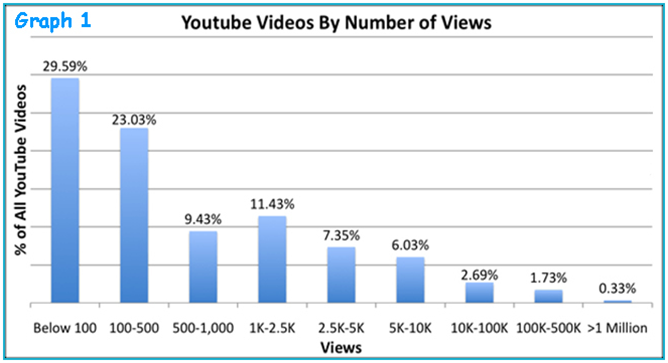
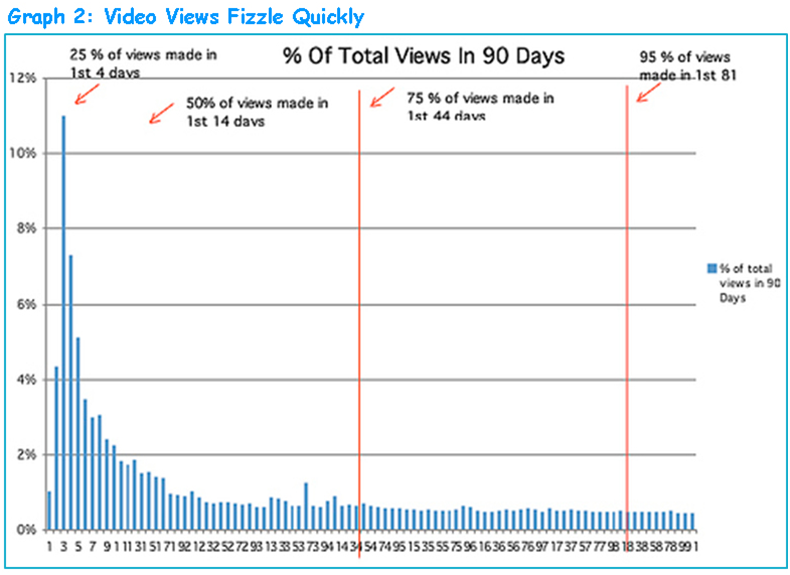
Ultimately, overall consumption of media will increase but hits become less frequent and each hit will become more niche.  The stats support this hypothesis, despite YouTube’s aggregate size and macro-level success, each clip’saverage viewership shows that regardless of whether the video is user-generated, premium or super-premium (for a definition of the differences click here), on average:
  • It will garner 500 views over time
  • 25% of those views will come in the first four days and
  • by and large, only the first 30 to 60 seconds will be watched.
How can you build a business on that?


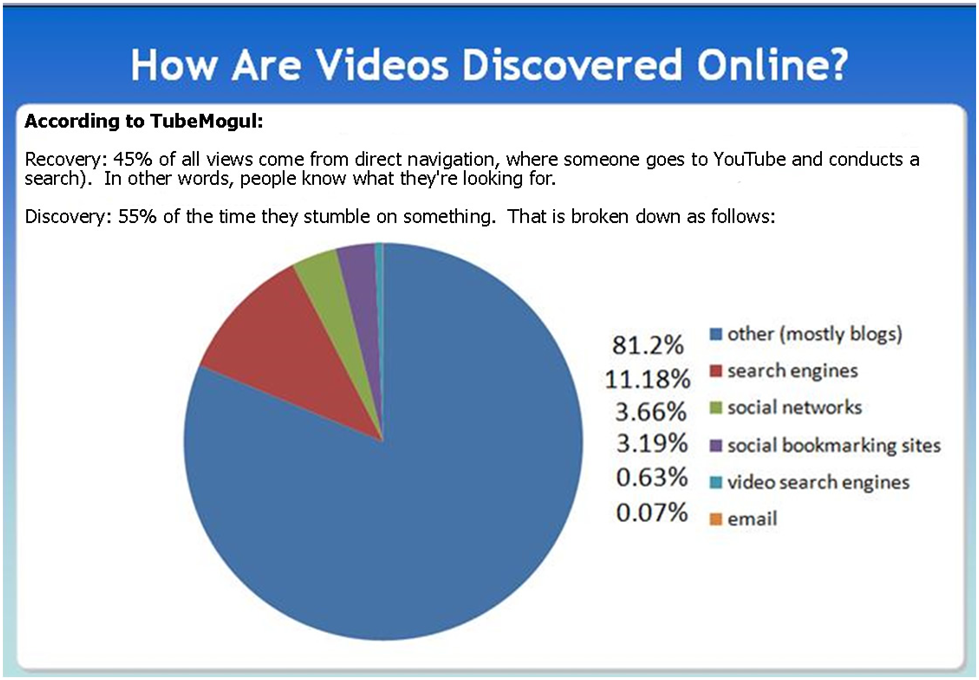
Factor 7: Discovery vs. Recovery
Exasperating matters is how content is actually unearthed.  To borrow from John Battelle’s breakdown of search: videos are found via recovery and discovery.
Statistics show that:
  • 45% of views come from direct navigation where a user goes to YouTube and searches to “recover” something they have already seen or are actively looking for.  Of course, YouTube is the world’s second largest search engine and most of those searches are now conducted on YouTube.com, which reinforces the argument that YouTube is now the best Internet M&A of all time.
  • The other 55% of the time, users stumble upon a video and “discover” it.  That is right, over half of the time, users land on something randomly.

In other words, while traditional media views the web as a place where pirates turn to to rip off their copyright, the truth is, only half of all of the content consumed is actually searched for, the other half is stumbled upon, meaning you actually have to distribute it widely enough to increase the likelihood that people even notice it, let alone give a damn!
This is why you need both lots of content and a diversity of it.  Indeed, Time.com former Managing Editor Josh Tyrangiel admitted that “long form journalism, a staple of magazines like Time, is not working” online.  The same applies to long form video online, and by extension, on mobile.
Factor 8: Size Matters
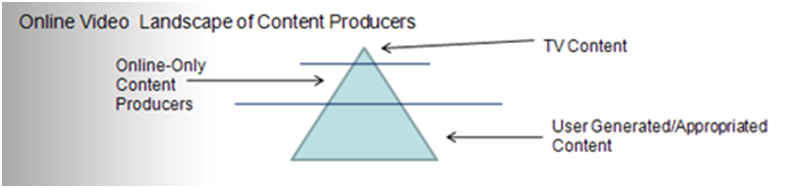
So what works?  To gain more insight into that (and to avoid an overly biased outlook), I reached out to Dina Kaplan, who is the COO of blip.tv.  (We use blip.tv’s video player on our web property).  According to Kaplan, a Pyramid of Content is emerging on the Web.
I tend to agree.  Back in February 2007, I wrote an article called “The Commoditization of Distribution and the Scalability of Content”.  In it, I alluded to a rudimentary pyramid with super premium on top, premium in the middle and UGC at the bottom:

It’s certainly not rocket science, and Kaplan and I are not alone in having that view.  She continues: “Hulu is the best-known platform sitting at the top of the pyramid, in terms of hosting and distributing network content.  YouTube, which has long been known for hosting great viral and one-off videos, has owned the bottom of the pyramid.”
The question remains: who will own the middle.  A couple of years ago, YouTube made a move towards “torso content”.  Kaplan’s blip.tv is obviously making a play for the middle, “blip.tv [wants to own] the middle of the content pyramid: the best original shows produced for the Web.  These shows are produced by talented individuals and production companies who are building up loyal audiences for their shows, just as the producers of a traditional TV show would.”
With things like Apple launching the iPad and IPTV gathering steam, Kaplan is confident that “shows will move around from screen to screen and you’ll choose to watch content on whatever screen is most convenient for you at that moment.”
Of course, with Boxee’s struggles to get traditional media on-board, one wonders if new media producers have a golden opportunity to win traditional ad dollars, which dwarf new media dollars by a wide margin.  For all the talk and excitement about online advertising and online video advertising, TV advertising in the US remains a $75 billion industry.


When you realize the dichotomy between the existing business that is Television and the potential that might be Online Video, you realize why the stakes are so high.  Come back next week when we update our Pyramid of Content to reflect the reality of 2010 and look at how videos will be monetized online.


Related articles by Zemanta
  • 31 Billion Web Videos Served in November (mashable.com)
  • Yahoo's revenue falls but exceeds expectations (sfgate.com)
  • Admit It, Microsoft: You Suck at the Web (gigaom.com)
Reblog this post [with Zemanta]
Read More View Comments | Posted by Fotis edit post

Meet WooRank

Google Inc.Image via Wikipedia

Meet WooRank. A website analysis tool designed to leverage search engines.
Increasing one's website visibility in the eyes of Google is the golden goal of any webmaster. No wonder a whole business called "Search Engine Optimization" is built around this yearning. Despite the countless experts of many kinds the SEO business is yet to be streamlined and reliable benchmark tools are sorely needed. Here comes WooRank.
How search-engine-friendly is your website?
WooRank is breaking new ground compared with other related services. In one single click it will analyze your website for conformance to SEO best practices and show how it ranks against the competition. Its real-time report consisting of 50 criterias in 6 different sections will help you to instantly spot critical issues that impact traffic, usability and lead generation. Now web professionals have an objective yardstick to know what Google looks for when crawling their websites.
Moreover WooRank will deliver easy-to-understand descriptions of identified problems and provide precious advice on how to fix them. More than one hundred personalized how-to tips are already available to achieve top rankings and drive additional traffic.
Improve natural search rank
From now on doing Search Engine Optimization without WooRank is like doing brain surgery with a hammer. In the next couple of months WooRank is going to launch a Premium edition of its service. While the current service will remain free yet constantly fine-tuned, the paid version will include many more professional-level features and greater advice to turn your website into an unshakable search engine leader. WooRank is intended to become the inevitable SaaS tool for anyone involved in online marketing.
Only 16% of Google searchers look beyond the first two pages of search results. WooRank will help you to get on top.

Related articles by Zemanta
  • Hostway First to Integrate AutomaticSiteMap to Boost Customers' Search Traffic (prweb.com)
  • Top 10 Small Business Technology Resolutions (seattlepi.com)
  • How To Improve Your Search Engine Ranking (ronmedlin.com)
Reblog this post [with Zemanta]
Read More View Comments | Posted by Fotis edit post

2009 online: the year in review

Image representing Google as depicted in Crunc...Image via CrunchBase
The end of the year presents and excellent opportunity for reflection, and also for lists. Combining the two, I’ve decided to reflect on the last year of online activity in the UK by providing a list of our most popular and commented on blogs over the last 12 months.

January
Our analysis of the decline in flight searches and the shift from flights to the USA and Eurozone countries to domestic and further flung destinations caused some controversy, but has broadly proved to be an accurate prediction as to what happened in the travel sector this year. This month we also highlighted the fact that social networking had come of age in the UK and overtaken pornography in terms of Internet visits.

February
Twitter was one of the fastest growing websites of 2009 and undoubtedly the most talked about. Thanks to a load of free publicity from Jonathon Ross and Stephen Fry, the micro-blogging service entered the top 100 in February and is currently one of the 30 most visited websites in the UK. We wrote more blogs about Twitter than any other site this year, but there was still space for other social media sites too. Two particularly good examples we highlighted this month were: The Telegraph using Digg to pick up traffic and the seemingly unstoppable rise of Martin Lewis, the MoneySavingExpert.

March
March was the month that Richard Seymour presented his excellent webinar analysing the ways in which us Brits use the different search engines. This post highlights the most searched for subjects on Google, Yahoo!, bing and Ask; while this one illustrates the results of some similar analysis carried out on Google News.

April
Twitter time again, and I’ve used a version of the chart in the post illustrating where people go after visiting Twitter in more presentations than I can count this year! This was also the month when we analysed the growing influence of social media on shopping websites and the SEO opportunity provided by shop opening times information (something that is particularly relevant over the Christmas period).

May
This was the month that the Telegraph broke the biggest domestic news story of the year: the MPs’ expenses scandal. We produced a couple of blogs: the first analysing search behaviour, the second looking at the impact on the Telegraph’s traffic.

June
In June our list of the top 100 student websites resulted in some good comment and debate in the blogosphere and on Twitter.

July
A pretty quiet month on the blog, primarily because I spent most of the month on paternity leave. Aside from that analysis of pregnancy searches, the most popular blog asked: ‘Are voucher searches on the decline?’ The answer was ‘No’, and this Christmas we’re predicting a 25% increase on last year.

August
In August we revealed that content driven websites now receive almost than twice as many UK Internet visits as transactional sites. Those are another two charts that I’ve included in a lot of presentations this year.

September
Another interesting month for social media, with Twitter overtaking MySpace and Capital One proving that Facebook can drive traffic to finance websites.

October
With retailers starting to smell to Christmas in the air, it was time for Experian Hitwise’s resident gadget expert Richard Seymour to start looking into his crystal ball and start predicting what products would be hot this festive season. His first bit of analysis showed Microsoft’s Xbox 360 finally overtaking perennial favourite the Nintendo Wii in our Hot Consumer Electronic List.

November
Although the recession isn’t yet officially over, there is no doubt that some green shoots are beginning to appear online. After a couple years writing about the impact of the credit crunch on online behaviour, it was nice to be able to highlight some positive news: the first annual increase in traffic to property websites in over two years.

December
The serious: the pre-Christmas online retail peak moved a week closer to Christmas this year. The clever: Richard Seymour successfully predicts that Joe McElderry will win the X Factor. The just plain wonderful: Hitwise data shows that Rage Against the Machine will steal the Christmas Number from Simon Cowell (and they did!)

From: http://weblogsfeed.hitwise.com/~r/hitwise/uk/~3/0ihVO1pSyNU/2009_online_the_year_in_review.html
Related articles by Zemanta
  • 400% Rise in Social Media Traffic due to Search Engines - Google (webmetricsguru.com)
  • PR & Marketing Thoughts for 2010 (centernetworks.com)
  • Top Ten Digital M&A Deals For 2010 (techcrunch.com)
Reblog this post [with Zemanta]
Read More View Comments | Posted by Fotis edit post

Ten Technologies That Will Rock 2010

Image representing Google as depicted in Crunc...Image via CrunchBase
Now that the aughts are behind us, we can start the new decade with a bang. So many new technologies are ready to make a big impact this year. Some of them will be brand new, but many have been gestating and are now ready to hatch. If there is any theme here it is the mobile Web. As I think through the top ten technologies that will rock 2010, more than half of them are mobile. But those technologies are tied to advances in the overall Web as well.

Below is my list of the ten technologies that will leave the biggest marks on 2010:

The Tablet: It’s the most anticipated product of the year. The mythical tablet computer (which everyone seems to be working on). There are beautiful Android tablets, concept tablets, and, of course, the one tablet which could define the category, the Apple Tablet. Or iSlate or whatever it’s called. If Steve Jobs is not working on a tablet, he’d better come up with one because anything else will be a huge disappointment.Why do we need yet another computer in between a laptop and an iPhone? We won’t really know until we have it. But the answer lies in the fact that increasingly the Web is all you need. As all of our apps and data and social lives move to the Web, the Tablet is the incarnation of the Web in device form, stripped down to its essentials. It will also be a superior e-reader for digital books, newspapers, and magazines, and a portable Web TV.

Geo: The combination of GPS chips in mobile phones, social networks, and increasingly innovative mobile apps means that geolocation is increasingly becoming a necessary feature for any killer app. I’m not just talking about social broadcasting apps like Foursquare and Gowalla. The advent of Geo APIs from Twitter , SimpleGeo, and hopefully Facebook will change the game by adding rich layers of geo-related data to all sorts of apps. Twitter just recently launched its own Geo API for Twitter apps and acquired Mixer Labs, which created the GeoAPI.

Realtime Search: After licensing realtime data streams from Twitter, Facebook, MySpace, and others, Google and Bing are quickly ramping up their realtime search. But realtime search is still treated as a silo, and is not regularly surfaced in the main search results page. In 2010, I expect that to change as the search engines learn for what types of searches it makes sense to show Tweets and other realtime updates. In the meantime, a gaggle of realtime search startups such as Collecta, OneRiot, and Topsy will continue to push the ball forward on the realtime search experience. Realtime search will also become a form of navigation, especially on Twitter and Facebook. The key will be to combine realtime search with realtime filters so that people are delivered not only the most recent information but the most relevant and authoritative as well.

Chrome OS: In November, Google gave the world a sneak peek at its Chrome operating system, which is expected to be released later this year. The Chrome OS is Google’s most direct attack on Windows with an OS built from the ground up to run Web apps fast and furious. Already a Google is rumored to be working on a Chrome Netbook which will show the world what is possible with it a “Web OS.” It sounds like it would be perfect for Tablet computers also (see above). Chrome is a risky bet for Google, but it is also potentially disruptive.

HTML5: The Web is built on HTML (Hypertext Markup Language) and the next version which has been taking form for a while is HTML5. Already browsers such as Firefox and Google’s Chrome (the browser, not the OS) are HTML5-friendly. Once HTML5 becomes more widespread across the Web, it will reduce the need for Flash or Silverlight plug-ins to view videos, animations, or other rich applications. They will all just be Web-native. HTML5 also supports offline data storage, drag-and-drop, and other features which can make Web apps act more like desktop apps. A lot of Websites will be putting HTML5 under the hood in 2010.

Mobile Video: With video cameras integrated into the latest iPhone 3GS and other Web phones, live video streaming apps are becoming more commonplace—both streaming from phones and to them. As mobile data networks beef up their 3G bandwidth and even start to tiptoe into true broadband with 4G (which Verizon is heading towards with its next-gen LTE network), mobile video usage will take off.

Augmented Reality: One of the coolest ways to use the camera lens on a mobile phone is with the increasing array of augmented reality apps. They add a layer of data to reality by placing everything from photos to Tweets to business listings directly on top of the live live image captured by the camera. Tonchidot’s Sekai Camera, Layar, GraffitiGeo and even Yelp are examples of augmented reality apps.

Mobile Transactions: As mobile phones become full-fledged computers, they can be used for mobile commerce also. One area poised to take off in 2010 are mobile payments and transactions. Twitter founder Jack Dorsey’s latest startup Square turns the iPhone into a credit card reader. Verifone has its competing product, as does Mophie. The idea is that any mobile phone can become a point of sale, and those mobile transactions can tie into back-end accounting, CRM, and other enterprise systems.

Android: Last year saw the launch of nearly two dozen Android-powered phones, including the Verizon Droid. In a few days, Google’s Nexus One will launch as the first Android phone which can be unlocked from any given carrier (it is launching with T-Mobile). Android is Google’s answer to the iPhone, and as it reaches critical mass across multiple carriers and handsets it is becoming increasingly attractive to developers. There are already more than 10,000 apps on Android, next year there will be even more. And other devices running on the mobile OS are launching as well.

Social CRM: We’ve seen the rise of Twitter and Facebook as social communication tools. This year, those modes of realtime communication will find their way deeper into the enterprise. Salesforce.com is set to launch Chatter, it’s realtime stream of enterprise data which interfaces with Twitter and Facebook and turn them into business tools. Startups like Yammer and Bantam Live are also making business more social.

Source: http://www.techcrunch.com/2010/01/01/ten-technologies-2010/


Related articles by Zemanta
  • Can a company have more than one game changing moment? (inquisitr.com)
  • Twitter co-founder wants to help businesses, individuals square up with credit cards (taragana.com)
  • Ballmer in 2010: Should He Stay or Should He Go Now? (computerworld.com)
  • Bella Buzz: Collaboration on Predictions for the Online World in 2010 (befluid.com)
Reblog this post [with Zemanta]
Read More View Comments | Posted by Fotis edit post

Where Digital Marketing Is Heading in 2010

In our discussions about what will happen in the digital marketing industry during the next 12 months, one overarching trend emerged: The basic rules of brand building are just as important for innovations in the digital space as they are for traditional forms of communication.

Using new technology won't in itself bring success; your digital communications still need to be creative, engaging and relevant if they are to cut it during the second decade of this century. Here are the first five of our top 10 trends for 2010. (We'll post the next five here tomorrow.)

Online display: Don't be blinded by the shiny and new.
In 2010, advertisers will experiment with new, larger ad formats. These formats may be initially attractive because they are different, but the basics of brand building beyond awareness shouldn't be ignored. Most of the new formats perform very well in the short term. Dynamic Logic has previously reported the high performance (brand impact) of video ads when they were first introduced. They found that video ad performance, relative to average ad performance, declined over a two year period following introduction as the novelty wore off. We'd expect this to be true for most of the new, larger ad formats and their progeny.

Ultimately, over the next several years only the fittest for these larger formats will survive. If they prove too intrusive, they may make people less favorable toward the advertised brand or the website on which they are served. Other advertisers and agencies will use these formats more cautiously, taking note of creative best practices gleaned from prior work.

Viral video will move from art to science.
As online video consumption continues to rise, advertisers increasingly value viral viewings as a clear and visible sign that their campaigns are engaging audiences. In response, viral video analytics are becoming sophisticated. YouTube has enhanced its video analytics offer, and companies such as Visible Measures and Unruly Media are providing comprehensive viral monitoring services across multiple online video platforms.

This information will fuel a more scientific approach to viral campaign planning. Rather than just place videos online and hope an audience will come, advertisers will invest in viral seeding strategies. They'll promote their videos via online influencers, Facebook video-sharing applications and targeted, paid placements. Advertisers will also become smarter about developing and selecting ads with the most viral video potential before they employ the seeding. A recent calibration exercise for Millward Brown's Link pre-test, for example, identified the creative factors which explain most of the variation seen in levels of viral viewing.

While there are likely to still be more misses than hits in the viral space, the opportunity of being next year's T-Mobile "Dance" or Evian's roller babies is something many marketers will plan for.

Gaming gets more social and mobile.
The ability to access Twitter and Facebook from the Xbox game system is one sign console gaming is becoming a lot more social. Games such as "Uncharted 2" already allow you to tweet your progress from within the game and we anticipate seeing these features implemented in more games. Microsoft's Project Natal promises to bring even more interactivity to gaming by supplanting controllers with your actual body movements, improving immensely on a model created by Nintendo. Perhaps the most promising and category-busting idea appears to be OnLive, a games-on-demand service that allows you to play any console or PC game on your TV or computer, without the need for a console at all.

Gaming's reach is already significant -- "Modern Warfare 2" is the biggest entertainment launch ever -- but the social elements are going to make the growth exponential. The proliferation of mobile games such as Doodle Jump for the iPhone, which allows the user to interact with other players, brings gaming to the masses.

Dynamic Logic's research has already shown that gaming can be very effective in increasing brand metrics. As interactivity increases and gaming becomes ubiquitous, we expect more advertisers to enter this space. For example, in the fall of 2010, Disney will launch "Epic Mickey" for the Nintendo Wii, the first major communication vehicle for a significant repositioning of this much-loved global brand.

Mobile takes a bite out of online.
According to the Mobile Marketing Association, total U.S. spend on mobile marketing will grow from $1.7 billion this year to $2.16 billion in 2010. Google's $750 million purchase of mobile ad network Admob reinforces that 2010 will be a significant year for mobile. We expect to see more consolidation in the mobile space.

With Apple's iPhone, Google's Android and RIM's BlackBerry platforms making the smartphone choices more attractive to consumers and cost of access slowly coming down, mobile web usage numbers will increase. The iPhone alone has now reached 57 million units worldwide, the fastest uptake in the history of technology. The real innovation will be increased adoption of the next-generation mobile browsers that will make the mobile web look and feel more like the applications we know today.

While web-based mobile, despite its growth, still only reaches a relatively small number of people, this niche audience can be particularly attractive to some brands and we've seen many targeting successes. Mobile provides the ability to target by site, phone model, demographics and location, all of which can be useful to advertisers. In addition, Dynamic Logic's normative advertising effectiveness data already suggests that mobile is two to five times better at driving brand metrics than online, and we expect this differential to remain consistent in 2010.

All of this means that mobile may well start to take ad dollars which would previously have been spent online. Since it's a new medium, there remains some consumer resistance to mobile advertising, so we advertisers will initially favor the soft-sell approach of providing useful content in this space, rather than pushing hard-sell messaging.

Here I am. Over here!
The promise that technology would enable automated direct-marketing messages to be pushed to consumers with GPS-enabled mobile devices has yet to come to fruition. Consumers are understandably reluctant to broadcast their location randomly or to be interrupted by unexpected messages without their consent. Instead we're seeing a variety of innovative solutions created to facilitate geo-targeting of marketing messages (when in-aisle, in-store or in-proximity) as the number of GPS-enabled devices continues to rise.

Services such as the mobile game FourSquare contain a social-media element that allows users to broadcast their location to a network of friends and other users in their respective cities. The social element of this voluntary disclosure has allowed marketers to tap into an engaged network of users and offer special promotions based on reported location. We expect FourSquare and other apps with a hybrid location/social-networking component to grow significantly in 2010.

We also expect to see utility-focused location applications gain popularity on GPS-enabled mobile devices during 2010. ComScore has reported that 11% of their mobile panel is currently using map or direction-based applications on their devices, representing 41% year-on-year growth and potentially stealing market share from standalone GPS devices. How these applications are eventually monetized remains to be seen, but the "Minority Report" scenario of "push" location-based advertising is starting to become a reality through voluntary user disclosure of location.

Even if consumers won't share their location with brands, brands can share their locations with consumers. In this vein, marketers will increasingly make location a feature of their campaigns, as the recent Levi's Twitter promotion in Australia demonstrates.

From: http://feedproxy.google.com/~r/advertisingAge/Digital/~3/gR498Gl4slA/post.php
Read More View Comments | Posted by Fotis edit post

The year in search: the UK experts' view | Blog | Econsultancy


What have been the most significant issues for search in 2009?

Ciaran Norris, Head of Social Media at Mindshare:
Twitter's tip into the mainstream, and the subsequent rush towards real-time search, has seen social and search collide like never before. Whilst I'm not convinced that the current Google/Twitter interface will stay, the thought behind it is the interesting thing.
On another note, the struggle by media companies to work out whether or not they want to be searchable anymore could have a profound impact on content over the coming years.
Will Critchlow, Director of Distilled:
I think with hindsight we will say that the increase in personalisation (and particularly Google's roll-out of personalisation even to non-signed-in users) will be viewed as the most significant event. It's really the end of the '#1 ranking' and it opens up an amazing array of new marketing tactics, especially for big brands.
Andrew Girdwood, Head of Search at Bigmouthmedia:
It’s hard not to talk about Bing when we examine what significant search events occurred in 2009. Even if you’re not a fan of Bing, even if you think Google will wipe the floor with Bing you would be wrong to suggest that Bing’s not had a visible influence on Google. If it was not for Bing we would likely still be waiting for Google to push its own real-time search and Twitter integration.
One of the areas search is growing is around personal identity. Google’s started to automatically personalise web search results. This is huge. Google and Facebook have been battling it out with competing “Connection” services; or universal logins. These are a corner stone to both companies' social media and personal targeting ambitions.
Kevin Gibbons, Director of Search at SEOptimise:
Personally from a UK search perspective I think one of the biggest issues in 2009 wasGoogle’s broken UK search results. It’s very rare that an algorithm update from Google reduces the relevancy or quality of search results, especially over such widespread results and for a long period of time.
This has generated a lot of attention and caused many headaches for UK SEOs trying to figure out why their sites/clients are listed behind US and Australian sites when searching in Google UK!
Despite the changes Google have been rolling out recently, I don’t think you can look past the Microsoft/Yahoo deal as the most significant event of the year. A realistic competitor to Google has been long-overdue, especially in the UK where they have such a dominant market share. Potentially the deal could make a significant impact to how advertisers allocate their online advertising budgets. So once Bing and adCenter replace Yahoo search it’s likely online marketers will be taking Bing far more seriously for organic and paid search strategies.
Shane Quigley, CEO at Epiphany:
As well as Bing's inclusion of Twitter search capability and Google's wide-scale rollout of universal search, 2009 has shown us that social factors will play a major role in 2010.

It is clear to me that the Vince update aimed at identifying brands was also a step towards monitoring social barometers to measure popularity. Things like tweets, brand mentions, links, images, videos and product reviews will all play a part in Googles future algorithm calculations.

What will be the major search trends in 2010?

Ciaran Norris:
I think that next year will see the continued convergence of technologies and channels, particularly TV, mobile, search & social. The real-time search movement will continue in some way, shape or form, though the engines still need to perfect ranking & filtering.
The continued rise of mobile web, pulling in GPS & augmented reality, means that people will expect geo-results. And as TV gets webbed up (Yahoo TV Widgets etc...) people searching and chatting on and around shows will become a new way of reaching people, or at least learning about what they want.
Will Critchlow:
I'm going to go out on a limb here and say that I think 2010 will see the beginnings of a backlash against Google. There have been murmurings for some time among the tech community about their all-pervading presence, ambition to gather everyone's data for their own marketing purposes and effective monopoly.
It wouldn't surprise me to see them take a step too far and face political push-back over their expansion into the desktop and mobile phone markets. If they use market power in one arena to manipulate another, that's classic monopolistic behaviour. Personally, I'd love to see Bing gain some market share. I think a strong competitor would ultimately benefit everyone.
Andrew Girdwood:
We’ll see continued improvements in visual search. Google Goggles is one example but we’ll also see mobile applications that effect an augmented reality that combine search and location-aware search. These will let searchers show the engines what they want help with and get back results.
Privacy will also be a hot issue in 2010. Targeting becomes ever more important to companies and yet the ability not to be targeted becomes ever more important to people. It seems impossible that we’ll avoid tension on this front.
Of particular interest will be looking beyond the last click. DoubleClick offers Click Path Analysis. Atlas offers User Engagement Mapping. There will be other offerings from alternative technology providers who wish to remain competitive against these search engine owned offerings. 2010 will see sites wrestle with tagging and tracking but invest in the required technology in 2010 with the ambition of not having to return to this fight for a while.
As real-time search helps surface social media sites in the blink of an eye the aspects of ‘search’, ‘marketing’, ‘public relations’ and even ‘customer care’ will all get drawn together. We’ll see different types of agencies pitching against one another for the first time. We’ll see corporate departments defending their turf and fighting for budget against their colleagues across the hall.
Kevin Gibbons:
Google page speed is going to have an influence over organic rankings in 2010 and is likely to have a strong impact on designers/developers as well as SEO’s. At the moment there are unanswered questions, such as how heavily will slow sites be penalised? Will fast sites be boosted in the search engines? So it will be interesting to see the impact this has.
Now that the Microsoft/Yahoo deal is now all tied-up, advertisers will need to start thinking seriously about Bing’s more sizeable market share and start to prepare for when this is integrated with Yahoo search.
Google Wave has been slowly rolled out to users so far during 2009, this has a lot of potential which is unlikely to be truly realised until it reaches a greater audience. There’s a lot of uncertainly about how popular Google Wave will become at the moment, so it will be very interesting to see if this can really take off in 2010. I’m sure they’ll be new social media sites coming onto the scene too, along with developments to many of the current top social media sites; Twitter business accounts, for example, will be a good one to look out for.
    Shane Quigley:
    Rumoured for a while, and discovered live on the web by a clever person over at Gizmodo, there is a new Google Interface on the way for 2010. Being referred to as the three panel layout this change will mean it will become increasing important to rank highly in Image, Video and other search results as Google gives more prominence to these sections within its interface.
    Real Time search has huge implications in terms of brand protection, what results people will click, as well as creating new opportunities to rank. Google also announced earlier this month that everyone’s search results are now being personalised (to an extent) based on your previous search behaviour, regardless of whether you’re logged in or not. Are the days of the ranking report now truly numbered?

    Changes will come thick and fast as Google look to hold market share and the new Caffeine architecture should give them the processing power to do a lot more with their search application.

    Related articles by Zemanta
    • Bing trying to get exclusive on Fox...smart (vator.tv)
    • What Everybody Ought To Know About The Future Of Twitter (shegeeks.net)
    • SEO Isn't Dead or Dying (techstartups.com)
    Reblog this post [with Zemanta]
    Read More View Comments | Posted by Fotis edit post

    21 ways to commit brand suicide in the 21st Century | Blog | Econsultancy

    I always believed that brand suicide was essentially the result of some major foot-in-mouth event, or a product fail of epic proportions. Moreover, it was not so much the failure itself, but rather the result of not being able to manage and recover from that failure. There’s a right way and a wrong way to dig your brand out of a hole.
    But this big picture stuff isn’t the only way brands die. When it comes down to it brands die at a micro level. Brand suicide occurs whenever an individual has ‘had it’ with a company, be that the result of shoddy treatment, or disappointment with products and services.
    Normally when this happens to me I tell people about it, in the strongest possible terms. That used to be a relatively limited group of people, but nowadays I can (and do) communicate my annoyance / misery on Twitter, which gives any disgruntled customer a lot more reach. And as such the world is a scarier place for brands than ever before.
    The vast social media echo chamber means that brands are now at real danger from lots of small events, rather than one big one. We are living in an age where brands die by 1,000 cuts, rather than one almighty chop. The rise in popularity of social / user-generated platforms like Facebook, Digg, Twitter, YouTube and Wikipedia means that brands are more exposed than ever.
    So how can brands go about killing themselves slowly?
    Spamfail. Everybody hates spam, which comes in many forms including emails, blog comments, social media spam, search engines spam, and old school spam such as junk mail. Too much of a bad thing is always a bad thing. Here are 10 ways to avoid spam.
    Faking it. Speaking of spam, some of the most ill-advised spam campaigns have involved company executives. Take Whole Foods CEO John Mackey, who – over a seven year period - posted anonymous comments on Yahoo’s stock market forums to criticise a competitor (while calling himself ‘cute’ in the process). Funny and embarrassing in equal measure. And also deceptive: the comments prompted an SEC investigation. He was cleared, he apologised (kind of), but the damage was done.
    Executive foot in mouth. John Mackey also ‘did a Gerald Ratner’ a few months ago by saying that his organic superstore “sells junk”. Ratner, a jewellery tycoon, almost caused the collapse of his company in the late-1980s after describing his products as “total crap”. Journalists simply love stories like this.
    Inappropriate hashtag piracy on Twitter. Hopping onto a trending hashtag can be a good idea, but you need to be creative and contextual. Otherwise things can get weird, as Habitat found out when an ‘intern’ responsible for the firm’s Twitter output decided to promote the firm by jumping onto threads relating to the protests in Iran.
    Hey, loyal customer: screw you. Nothing smarts more than insurance premiums being raised for no good reason, especially when you’ve stayed with the insurer for years. Shouldn’t my premium fall? It’s the same with mobile operators, where customer churn is a massive issue, and for many other firms too. It’s madness, frankly, especially as it typically costs far less to retain a customer than to acquire a new one. So why do businesses penalise loyal customers while offering new ones amazing deals? I’d wager that it’s linked to the way bonuses are paid, as much as anything. The sooner we move on from that the better. Businesses need to evolve into retention-focused operations, where staff are rewarded on the basis of customer loyalty, satisfaction and profitability, rather than sales.
    Punish tiny indiscretions. True story: back in 2002 I was placed on an ‘arrears plan’ by Vodafone after missing just one lousy payment, the first time I had done so in three or four years. With an unblemished payment history up until that point I couldn’t understand it, but I was assured that there was no room for movement. Annoyingly the ‘arrears plan’ meant that a black mark was added to my credit file. As such I left Vodafone almost immediately and shall never return.
    Over-promise, under-deliver. After leaving Vodafone I was enticed towards 3, the UK mobile operator with the first 3G network. Unfortunately something went badly wrong and the handset I was sent refused to send a text message for the best part of six months. So much for the joys of 3G. I spent around 30 hours on the phone trying to resolve the issue, and now have a mortal fear of Norah Jones (the hold music).
    Customer service fail. Where to start with this one? I’ll do almost anything, including ignoring a problem that costs me money every month, just to avoid calling the customer service centre. This visualisation, called ‘Why I’d rather be punched in the testicles than call customer service’, perfectly illustrates why call centres suck so badly.
    Kick the shit out of a Good Samaritan. Ladies and gentlemen, I give you Ryanair vs blogger. Constructive criticism is part and parcel of the world we live in. You can take it personally, as Ryanair did (backed up, amazingly, by its PR department who put out a statement along the lines of: “lunatic bloggers can have the blog sphere all to themselves as our people are too busy driving down the cost of air travel”) or you can take it on the chin and fix up those problem areas.
    Do the heavy-handed PR / legal thing. The world has irreversibly changed, and old school wool-pulling – and threats – don’t seem to work so well anymore. I am of course referring to the Trafigura scandal and subsequent attempt to hush things up. A superinjunction was imposed on The Guardian but the crowd came to the rescue, with bloggers and Twitter users standing up for free speech. This PR / legal spin has been an utter disaster for all involved, and it had the opposite effect of quietening the press (it trended on Twitter for a couple of days). The takeway here is that transparency is the only way of protecting a brand under fire.
    Crap advertising. “Mum, I want to do a poo.” Discuss...


    Horrific advertising. I’m all for edgy, but the decision to drape models over Berlin’s Memorial to the Murdered Jews of Europe for a recent EasyJet brochure was jaw-droppingly stupid.
    Intrusive advertising. Here’s a fact: if you commission pop-ups, you totally suck andeverybody hates you.

    [Image by Pascal PirateChickan]
    Launch a rubbish website. It’s obviously not going to be a good thing for your brand, is it? Instead of naming and shaming I’m going to simply point you at Vincent Flanders. Tell us how it is, Vince…
    Launch a rubbish, inaccessible website. Some people will hate your website because it has a shocking user experience. Meanwhile others will hate it because they can’t use it. Why would you want to alienate customers or prospects? Mac owners, sight-impaired people and the 80+ generation are all internet users, and there are lots of them. Flash websites are some of the worst offenders, as major retailers have found to their embarrassment.
    Bastardise your brand identity. Completely. Changing the look and feel of your brand is always a little bit dangerous, even when it is necessary. Do too much, too soon, and you might have a problem. Consider what happened with British Airways when it redesigned the tail fins on all of its aircraft, replacing the Union Jack with ‘world art’, at a cost of £60m. Cue a massive public outcry. Despite this it took the company four years to ditch the ‘ethnic liveries’. Moral: be careful when messing with your brand’s appearance.
    Ignore a major / killer problem with your products. What use are bike locks that can be opened with a biro? Or what about cars that kill people due to accelerator pedals sticking? Obviously no consumer in their right mind would risk buying these products. Product recalls can be horrendously expensive btu if you know there’s a problem then it’s better to deal with the situation sooner rather than later (the longer you leave it, the worse the problem gets, and the more the brand becomes tarnished).
    Introduce ridiculous charges. Banks are some of the worst offenders but once again there’s no need to look any further than Ryanair, which is surely the king of silly charges (although they often result in lots of noise in the press, which I imagine may be part of the grand plan). Ryanair charges £5 simply to book a ticket via credit card. It charges if you take a bag with you, and also if you don’t. It even considered charging passengers to use the toilet (seriously).
    Rubbish delivery. Online retailers are judged not only by their websites and prices, but also by service, and that means – by and large – the ability to deliver on-time and without charging astronomical fees. Consumer expectations are sharper than ever in this area. Retailers cannot expect someone to wait at home all day simply to receive some oversized package, purchased via the internet. The retailer may blame the courier, but the consumer will apportion a fair amount of blame to the retailer.
    Sack the wrong people. You can lose a lot of respect by firing the wrong people. For example Microsoft recently let Don Dodge go, as part of a bigger wave of layoffs. In the eyes of the startup community this was a serious blunder, which was perhaps exacerbated by the fact that Google picked him up within 90 minutes of him clearing his desk.
    Burying your head in the sand. If there's one surefire way of committing brand suicide then it's to ignore problems and bad noise. Reputation monitoring is essential these days. I'm not saying you should reply to every single tweet that mentions your brand, but certainly you can reply to those people who say something negative. If you choose not to then that's your call, but if you say you "can't possibly reply to everybody" then you're very probably wrong. Remember that a problem is really an opportunity to surpass customer expectations, and to drive loyalty through quality service.
    What did I miss? I'm sure there are dozens more ways of harming your brand... leave your ideas and pointers below...


    Related articles by Zemanta
    • Using Social Media To Enhance Your Marketing (slideshare.net)
    • Internet Vices: Twitter is Crack Cocaine [PIC] (mashable.com)
    • Add Chat and Drag & Drop Sharing to Your Site With Meebo Bar (mashable.com)
    • Mozzler Comes Full Circle And Turns Its Realtime News Stream Into A Reader (Private Beta Invites) (techcrunch.com)
    Reblog this post [with Zemanta]
    Read More View Comments | Posted by Fotis edit post
    Newer Posts Older Posts Home

    The Affiliate Post

  • What is this?
      This is collection of my thoughts and of all the interesting things I come across while surfing.
  • AddThis


    Bookmark and Share

    Blogger Widget from Evri

    Content recommendations from Evri

    Fotis' shared items

    Labels

    • Facebook (7)
    • Google (7)
    • Twitter (6)
    • Social media (4)
    • Web search engine (4)
    • Web Design and Development (3)
    • YouTube (3)
    • Advertising (2)
    • Business (2)
    • Digg (2)
    • Internet marketing (2)
    • Microsoft (2)
    • Promotion (2)
    • Search (2)
    • Search Engines (2)
    • Search engine optimization (2)
    • Social network (2)
    • Website (2)
    • Yahoo (2)
    • AOL (1)
    • Affiliate marketing (1)
    • Andy Beal (1)
    • Apple (1)
    • Authoring (1)
    • BehavioralTargeting (1)
    • Bing (1)
    • Bookmaker (1)
    • British people (1)
    • CBS (1)
    • CNET Networks (1)
    • Cisco Systems (1)
    • Click-through rate (1)
    • ComScore (1)
    • Common Craft (1)
    • Daily Mail (1)
    • Fuze Box (1)
    • Google Browser Size (1)
    • Google Labs (1)
    • HTML (1)
    • IKEA (1)
    • Internet privacy (1)
    • Internet service provider (1)
    • Jack Dorsey (1)
    • John Mackey (1)
    • Ladbrokes (1)
    • London (1)
    • Malmö (1)
    • Money (1)
    • MySpace (1)
    • Newspaper (1)
    • Online Communities (1)
    • Online advertising (1)
    • Patrick Moran (1)
    • Pay-Per-Click Advertising (1)
    • Pennsylvania (1)
    • Privacy (1)
    • Security (1)
    • Shawn Collins (1)
    • Simon Cowell (1)
    • Social network service (1)
    • Software as a service (1)
    • Steve Jobs (1)
    • Store manager (1)
    • Sweden (1)
    • Television (1)
    • Uniform Resource Locator (1)
    • United States (1)
    • Viacom (1)
    • Victoria (1)
    • Web banner (1)
    • WebEx (1)
    • Webmaster Resources (1)
    • iPhone (1)
    • search-engine (1)

    Blog Archive

    • ▼ 2011 (1)
      • ▼ January (1)
        • 20 predictions for the next 25 years
    • ► 2010 (8)
      • ► July (1)
      • ► June (2)
      • ► April (1)
      • ► January (4)
    • ► 2009 (15)
      • ► December (6)
      • ► November (3)
      • ► October (6)
    • ► 2007 (1)
      • ► February (1)
    • ► 2006 (1)
      • ► September (1)
  • Search


    • Home
    • Posts RSS
    • Comments RSS
    • Edit

    © Copyright The Affiliate Post . All rights reserved. | Blog Skins Designed by FTL Wordpress Themes

    Back to Top