• Home
  • Posts RSS
  • Comments RSS
  • Edit
Blue Orange Green Pink Purple

Still under construction ;)

-------------------------------------
Showing posts with label YouTube. Show all posts

Context is King: How Videos Are Found And Consumed Online

YouTube, LLCImage via Wikipedia

To try to understand—let alone guess—the future of video advertising, one needs to start by looking at the biggest trend in media over the past few decades.  In November 2006, Bear Stearns Cable and Satellite analyst Spencer Wang published a study called “Why Aggregation & Context and Not (Necessarily) Content are King in Entertainment”.  While Bear Stearns has since been acquired by JP Morgan and is now a mere footnote in business books, the study’s findings are more relevant than ever.  Let’s examine 8 key factors behind online video consumption
Factor 1: Media is Fragmenting

According to a recent NY Times article, in the 1952-53 season, more than 30% of American households watched NBCduring prime time, according to Nielsen.  In fact, up until twenty years ago, you could buy a 30-second spot on CBS, NBC or ABC and reach “everyone.”  Today, NBC’s prime time reach is 5%.  Sure, NBC is lagging CBS and ABC, but neither the Tiffany network nor Disney’s counterpart is faring much better.  The secret’s out: fewer people watch TV and teenagers spend every waking minute connected to the Internet, increasingly through the mobile web.
Factor 2: Deportalization is Here to Stay
As the media world becomes fragmented and consumers move online, the Web is following a similar path, known as deportalization: the move away from the dominant portals of old, as social networks gain huge followings and vertical niche sites gain smaller, but more loyal, followings.
Ten years ago, you could buy a banner on MSN, AOL or Yahoo and reach “everyone” on the Web.  Five years ago, you could get the same result by buying a text link through AdWords and reach consumers who were either searching directly on Google.com, or surfing on the countless number of websites that were part of Google’s publisher network through AdSense.
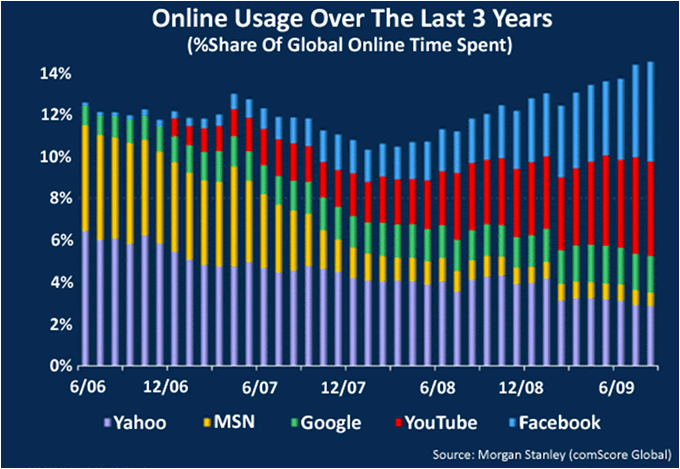
Suffice to say, times have changed.  In fact, less and less often do consumers even seek out content  by actually going to a given site.  To paraphrase Jeff Jarvis, if something is important, it will find me, be it via newsletter,Facebook, Twitter or a shared link in an email.  In fact, Facebook might very well be the last giant Web property and when it launched Facebook Connect, it too began to extend its tentacles across the Web.  Twitter’s growth hasmaintained thanks to its off-site (API) growth, while YouTube exploded due to its open embeddable nature from the get-go.
However, after YouTube sold to Google for $1.65 billion and the site’s aggregate traffic soared, some video producers tried to find a way to generate an audience—and revenues—outside of YouTube in order to build a legitimate business.  In other words, media is becoming fragmented, the Web is becoming deportalized, and the front line of it all is online video.
Factor 3: Content is Not a Zero-Sum Game
If we return for a second to television, it’s worth noting that with the advent of cable television, as the number of channels rose, so did overall content consumption.

Analogously, as the number of content producers and distribution points increases online, consumption increases exponentially.  For proof, look no further than the recent comScore figures touting over 31 billion videos were viewed in November 2009.
Factor 4: Content is King?
Indeed, to paraphrase Viacom’s Chairman Sumner Redstone: content becomes more important than distribution mechanisms; as new channels of distribution creep up, it is the content that is always going to be necessary, hence the adage “content is king”.  If you fast forward to 2010, it’s true that with all of these social media aggregation and distribution tools, you are seeing media rise to the surface.  No one, after all, cares about the pipes; it’s what flows through the pipes that matters.  The context—Facebook, Twitter, email—in which people are introduced to media and consume it is becoming more important than the content itself.  Content is no longer king, context is.
Factor 5: Demand for Content is Elastic, Supply of Funds is Not
The problem, as you can imagine, is that while it’s perfectly plausible for global advertising to grow, it will not grow fast enough to feed all of the mouths at the creative table.  As “consumer touch points” increase, the number of people that each piece of content reaches becomes smaller at the time of publishing/broadcast but can grow over time.  That’s the theory, anyway.
This is a double-whammy trend.  It is negative because the audience for something (and corresponding revenue) will be less than what the most popular event on television will be, which partially explains the cachet television still has over its online brethren.
But it is also a positive trend in that as a content owner you will be able to derive more revenue over the course of the content’s shelf life.  Don’t get me wrong, syndication on television is an enormous revenue stream, but that is not an option for all programming, whereas online, technically, anything has both a shot at building an audience and having some kind of residual revenue stream.  The problem is that there is no vetting process per se online so the lowest common denominator can be zero.
Factor 6: Chasing Hits Has Proven Futile
Ultimately, overall consumption of media will increase but hits become less frequent and each hit will become more niche.  The stats support this hypothesis, despite YouTube’s aggregate size and macro-level success, each clip’saverage viewership shows that regardless of whether the video is user-generated, premium or super-premium (for a definition of the differences click here), on average:
  • It will garner 500 views over time
  • 25% of those views will come in the first four days and
  • by and large, only the first 30 to 60 seconds will be watched.
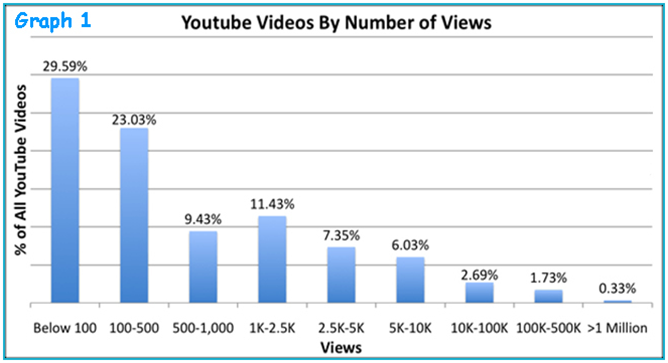
How can you build a business on that?


Factor 7: Discovery vs. Recovery
Exasperating matters is how content is actually unearthed.  To borrow from John Battelle’s breakdown of search: videos are found via recovery and discovery.
Statistics show that:
  • 45% of views come from direct navigation where a user goes to YouTube and searches to “recover” something they have already seen or are actively looking for.  Of course, YouTube is the world’s second largest search engine and most of those searches are now conducted on YouTube.com, which reinforces the argument that YouTube is now the best Internet M&A of all time.
  • The other 55% of the time, users stumble upon a video and “discover” it.  That is right, over half of the time, users land on something randomly.
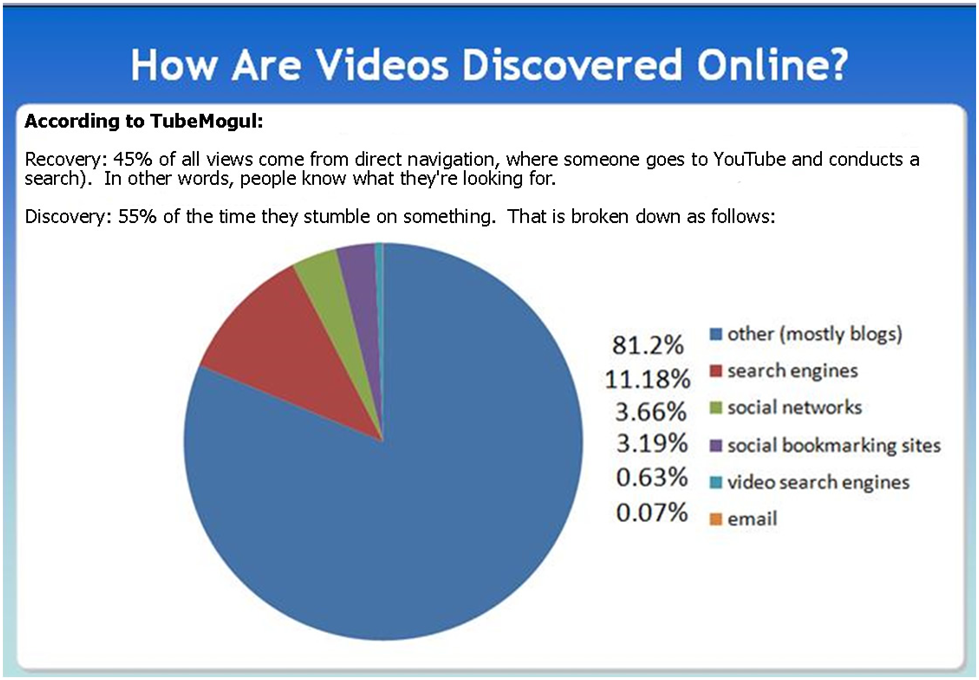
In other words, while traditional media views the web as a place where pirates turn to to rip off their copyright, the truth is, only half of all of the content consumed is actually searched for, the other half is stumbled upon, meaning you actually have to distribute it widely enough to increase the likelihood that people even notice it, let alone give a damn!
This is why you need both lots of content and a diversity of it.  Indeed, Time.com former Managing Editor Josh Tyrangiel admitted that “long form journalism, a staple of magazines like Time, is not working” online.  The same applies to long form video online, and by extension, on mobile.
Factor 8: Size Matters
So what works?  To gain more insight into that (and to avoid an overly biased outlook), I reached out to Dina Kaplan, who is the COO of blip.tv.  (We use blip.tv’s video player on our web property).  According to Kaplan, a Pyramid of Content is emerging on the Web.
I tend to agree.  Back in February 2007, I wrote an article called “The Commoditization of Distribution and the Scalability of Content”.  In it, I alluded to a rudimentary pyramid with super premium on top, premium in the middle and UGC at the bottom:

It’s certainly not rocket science, and Kaplan and I are not alone in having that view.  She continues: “Hulu is the best-known platform sitting at the top of the pyramid, in terms of hosting and distributing network content.  YouTube, which has long been known for hosting great viral and one-off videos, has owned the bottom of the pyramid.”
The question remains: who will own the middle.  A couple of years ago, YouTube made a move towards “torso content”.  Kaplan’s blip.tv is obviously making a play for the middle, “blip.tv [wants to own] the middle of the content pyramid: the best original shows produced for the Web.  These shows are produced by talented individuals and production companies who are building up loyal audiences for their shows, just as the producers of a traditional TV show would.”
With things like Apple launching the iPad and IPTV gathering steam, Kaplan is confident that “shows will move around from screen to screen and you’ll choose to watch content on whatever screen is most convenient for you at that moment.”
Of course, with Boxee’s struggles to get traditional media on-board, one wonders if new media producers have a golden opportunity to win traditional ad dollars, which dwarf new media dollars by a wide margin.  For all the talk and excitement about online advertising and online video advertising, TV advertising in the US remains a $75 billion industry.
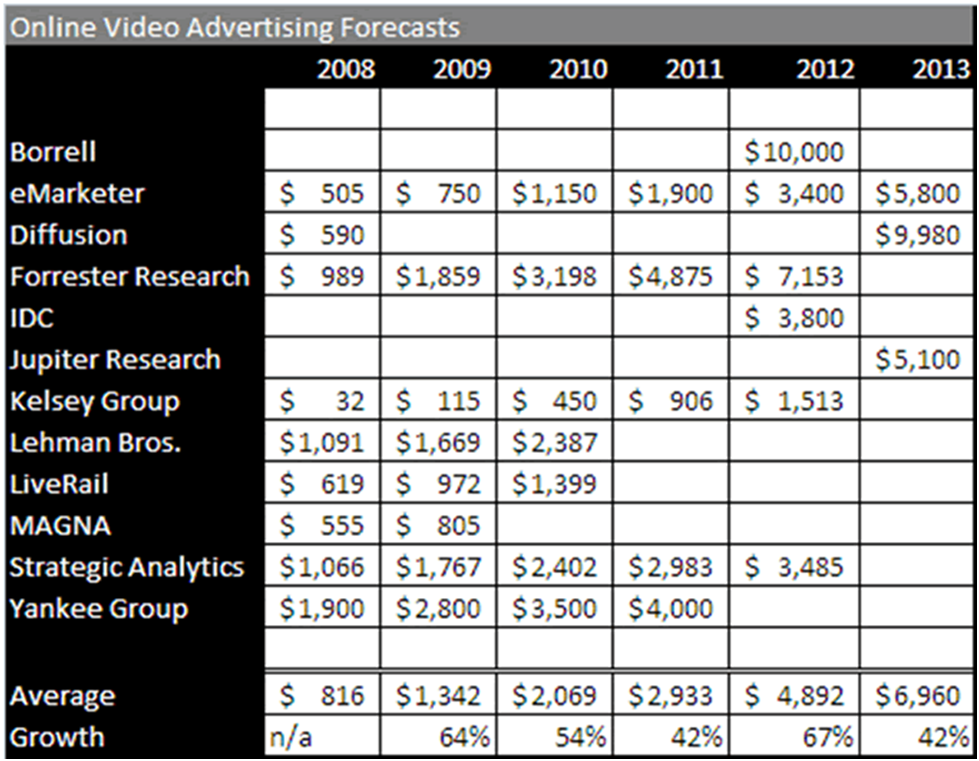

When you realize the dichotomy between the existing business that is Television and the potential that might be Online Video, you realize why the stakes are so high.  Come back next week when we update our Pyramid of Content to reflect the reality of 2010 and look at how videos will be monetized online.


Related articles by Zemanta
  • 31 Billion Web Videos Served in November (mashable.com)
  • Yahoo's revenue falls but exceeds expectations (sfgate.com)
  • Admit It, Microsoft: You Suck at the Web (gigaom.com)
Reblog this post [with Zemanta]
Read More View Comments | Posted by Fotis edit post

21 ways to commit brand suicide in the 21st Century | Blog | Econsultancy

I always believed that brand suicide was essentially the result of some major foot-in-mouth event, or a product fail of epic proportions. Moreover, it was not so much the failure itself, but rather the result of not being able to manage and recover from that failure. There’s a right way and a wrong way to dig your brand out of a hole.
But this big picture stuff isn’t the only way brands die. When it comes down to it brands die at a micro level. Brand suicide occurs whenever an individual has ‘had it’ with a company, be that the result of shoddy treatment, or disappointment with products and services.
Normally when this happens to me I tell people about it, in the strongest possible terms. That used to be a relatively limited group of people, but nowadays I can (and do) communicate my annoyance / misery on Twitter, which gives any disgruntled customer a lot more reach. And as such the world is a scarier place for brands than ever before.
The vast social media echo chamber means that brands are now at real danger from lots of small events, rather than one big one. We are living in an age where brands die by 1,000 cuts, rather than one almighty chop. The rise in popularity of social / user-generated platforms like Facebook, Digg, Twitter, YouTube and Wikipedia means that brands are more exposed than ever.
So how can brands go about killing themselves slowly?
Spamfail. Everybody hates spam, which comes in many forms including emails, blog comments, social media spam, search engines spam, and old school spam such as junk mail. Too much of a bad thing is always a bad thing. Here are 10 ways to avoid spam.
Faking it. Speaking of spam, some of the most ill-advised spam campaigns have involved company executives. Take Whole Foods CEO John Mackey, who – over a seven year period - posted anonymous comments on Yahoo’s stock market forums to criticise a competitor (while calling himself ‘cute’ in the process). Funny and embarrassing in equal measure. And also deceptive: the comments prompted an SEC investigation. He was cleared, he apologised (kind of), but the damage was done.
Executive foot in mouth. John Mackey also ‘did a Gerald Ratner’ a few months ago by saying that his organic superstore “sells junk”. Ratner, a jewellery tycoon, almost caused the collapse of his company in the late-1980s after describing his products as “total crap”. Journalists simply love stories like this.
Inappropriate hashtag piracy on Twitter. Hopping onto a trending hashtag can be a good idea, but you need to be creative and contextual. Otherwise things can get weird, as Habitat found out when an ‘intern’ responsible for the firm’s Twitter output decided to promote the firm by jumping onto threads relating to the protests in Iran.
Hey, loyal customer: screw you. Nothing smarts more than insurance premiums being raised for no good reason, especially when you’ve stayed with the insurer for years. Shouldn’t my premium fall? It’s the same with mobile operators, where customer churn is a massive issue, and for many other firms too. It’s madness, frankly, especially as it typically costs far less to retain a customer than to acquire a new one. So why do businesses penalise loyal customers while offering new ones amazing deals? I’d wager that it’s linked to the way bonuses are paid, as much as anything. The sooner we move on from that the better. Businesses need to evolve into retention-focused operations, where staff are rewarded on the basis of customer loyalty, satisfaction and profitability, rather than sales.
Punish tiny indiscretions. True story: back in 2002 I was placed on an ‘arrears plan’ by Vodafone after missing just one lousy payment, the first time I had done so in three or four years. With an unblemished payment history up until that point I couldn’t understand it, but I was assured that there was no room for movement. Annoyingly the ‘arrears plan’ meant that a black mark was added to my credit file. As such I left Vodafone almost immediately and shall never return.
Over-promise, under-deliver. After leaving Vodafone I was enticed towards 3, the UK mobile operator with the first 3G network. Unfortunately something went badly wrong and the handset I was sent refused to send a text message for the best part of six months. So much for the joys of 3G. I spent around 30 hours on the phone trying to resolve the issue, and now have a mortal fear of Norah Jones (the hold music).
Customer service fail. Where to start with this one? I’ll do almost anything, including ignoring a problem that costs me money every month, just to avoid calling the customer service centre. This visualisation, called ‘Why I’d rather be punched in the testicles than call customer service’, perfectly illustrates why call centres suck so badly.
Kick the shit out of a Good Samaritan. Ladies and gentlemen, I give you Ryanair vs blogger. Constructive criticism is part and parcel of the world we live in. You can take it personally, as Ryanair did (backed up, amazingly, by its PR department who put out a statement along the lines of: “lunatic bloggers can have the blog sphere all to themselves as our people are too busy driving down the cost of air travel”) or you can take it on the chin and fix up those problem areas.
Do the heavy-handed PR / legal thing. The world has irreversibly changed, and old school wool-pulling – and threats – don’t seem to work so well anymore. I am of course referring to the Trafigura scandal and subsequent attempt to hush things up. A superinjunction was imposed on The Guardian but the crowd came to the rescue, with bloggers and Twitter users standing up for free speech. This PR / legal spin has been an utter disaster for all involved, and it had the opposite effect of quietening the press (it trended on Twitter for a couple of days). The takeway here is that transparency is the only way of protecting a brand under fire.
Crap advertising. “Mum, I want to do a poo.” Discuss...


Horrific advertising. I’m all for edgy, but the decision to drape models over Berlin’s Memorial to the Murdered Jews of Europe for a recent EasyJet brochure was jaw-droppingly stupid.
Intrusive advertising. Here’s a fact: if you commission pop-ups, you totally suck andeverybody hates you.

[Image by Pascal PirateChickan]
Launch a rubbish website. It’s obviously not going to be a good thing for your brand, is it? Instead of naming and shaming I’m going to simply point you at Vincent Flanders. Tell us how it is, Vince…
Launch a rubbish, inaccessible website. Some people will hate your website because it has a shocking user experience. Meanwhile others will hate it because they can’t use it. Why would you want to alienate customers or prospects? Mac owners, sight-impaired people and the 80+ generation are all internet users, and there are lots of them. Flash websites are some of the worst offenders, as major retailers have found to their embarrassment.
Bastardise your brand identity. Completely. Changing the look and feel of your brand is always a little bit dangerous, even when it is necessary. Do too much, too soon, and you might have a problem. Consider what happened with British Airways when it redesigned the tail fins on all of its aircraft, replacing the Union Jack with ‘world art’, at a cost of £60m. Cue a massive public outcry. Despite this it took the company four years to ditch the ‘ethnic liveries’. Moral: be careful when messing with your brand’s appearance.
Ignore a major / killer problem with your products. What use are bike locks that can be opened with a biro? Or what about cars that kill people due to accelerator pedals sticking? Obviously no consumer in their right mind would risk buying these products. Product recalls can be horrendously expensive btu if you know there’s a problem then it’s better to deal with the situation sooner rather than later (the longer you leave it, the worse the problem gets, and the more the brand becomes tarnished).
Introduce ridiculous charges. Banks are some of the worst offenders but once again there’s no need to look any further than Ryanair, which is surely the king of silly charges (although they often result in lots of noise in the press, which I imagine may be part of the grand plan). Ryanair charges £5 simply to book a ticket via credit card. It charges if you take a bag with you, and also if you don’t. It even considered charging passengers to use the toilet (seriously).
Rubbish delivery. Online retailers are judged not only by their websites and prices, but also by service, and that means – by and large – the ability to deliver on-time and without charging astronomical fees. Consumer expectations are sharper than ever in this area. Retailers cannot expect someone to wait at home all day simply to receive some oversized package, purchased via the internet. The retailer may blame the courier, but the consumer will apportion a fair amount of blame to the retailer.
Sack the wrong people. You can lose a lot of respect by firing the wrong people. For example Microsoft recently let Don Dodge go, as part of a bigger wave of layoffs. In the eyes of the startup community this was a serious blunder, which was perhaps exacerbated by the fact that Google picked him up within 90 minutes of him clearing his desk.
Burying your head in the sand. If there's one surefire way of committing brand suicide then it's to ignore problems and bad noise. Reputation monitoring is essential these days. I'm not saying you should reply to every single tweet that mentions your brand, but certainly you can reply to those people who say something negative. If you choose not to then that's your call, but if you say you "can't possibly reply to everybody" then you're very probably wrong. Remember that a problem is really an opportunity to surpass customer expectations, and to drive loyalty through quality service.
What did I miss? I'm sure there are dozens more ways of harming your brand... leave your ideas and pointers below...


Related articles by Zemanta
  • Using Social Media To Enhance Your Marketing (slideshare.net)
  • Internet Vices: Twitter is Crack Cocaine [PIC] (mashable.com)
  • Add Chat and Drag & Drop Sharing to Your Site With Meebo Bar (mashable.com)
  • Mozzler Comes Full Circle And Turns Its Realtime News Stream Into A Reader (Private Beta Invites) (techcrunch.com)
Reblog this post [with Zemanta]
Read More View Comments | Posted by Fotis edit post

5 Tips for Using Video to Grow Your Business in 2010

December 9th, 2009 | by Patrick Moran


Patrick Moran is chief strategy officer at Fuze Box, the company behind Fuze Meeting. He was also chief marketing officer at Mzinga, a leading social media and white label community provider, and led online marketing at Cisco WebEx. Fuze Box is one of the leading providers of real-time video collaboration tools today.
 
It’s no secret that online video is hot. A recent study by comScore revealed that in October 2009, more than 167 million viewers in the U.S. watched an average of 167 videos each, while YouTube reached 1 billion views per day – or 41 million views per hour – in the same month.


At my company, we’ve seen our own surge in video viewing. Video now accounts for the largest number of files uploaded into online meetings on our platform.

Given that many of our customers work in sales and marketing, what I infer from these numbers is that video marketing is poised for a huge year in 2010. The reason is clear: video simply engages people in a way that static text and images cannot. There are dozens of studies that show the power of video to boost customer interaction, drive sales, encourage viral sharing, and build brand awareness. And according to MarketingSherpa, 95 percent of the companies that have used online video marketing are happy with the results and expect to use it again in the future.

Luckily, it’s never been easier to create marketing videos. You can create videos for free using stock images and still photos on services like Jivox, or even transfer existing TV spots to the Web. You can also create screencasts on sites like Screenr in under an hour by recording voice over still images, screenshots, and slides. If you want to shoot your own video, you can edit the footage using sites like Pixorial or Jaycut. Of course, you can also hire a video production agency to create the videos for you.

Whatever type of video you create, make sure it’s short – under two minutes is usually best, but 30 seconds is even better. Simplicity is also key. Keep voiceovers straightforward and music at a minimum. If you want an example of the power of utter simplicity, check out the unique videos that explain hundreds of complex subjects produced by Common Craft.

Here are some great ways to use video to boost your business next year:

1. Punch Up Your Web Site

The easiest way get started is simply to embed your videos on your Web site. You can use YouTube to do this, or alternatives like Vimeo or Sorenson Media. Once you’ve got the videos playing on your site, make sure they are easy to share by adding a “share this” button on each video so that viewers can pass them along via Twitter, Facebook, and other viral channels. Already on Twitter, 8 percent of all shared URLs are links to videos on YouTube.

2. Use Video to Sell

Wistia Image
We’ve found that our sales reps see 20 percent higher close rates when they play a video at the beginning of their virtual sales demo. Other online services report similar results: Jivox, an online video ad platform, used this video demo on their web site to increase registrations by 25 percent – they even embedded a signup form right on the demo page to collect registrations. You can also use services like Wistia to share a video with prospects and track how they interact with the video.

3. Use Video in Your Online Ads

Online video ads are growing in popularity because they are effective in driving sales. According to a study by the Online Publishers Association, 52 percent of people who watched an online video ad took action after viewing the ad, such as visiting the advertiser’s website (31 percent) or searching online for more information on the product (22 percent). A full 12 percent went on to make a purchase – giving video ads one of the highest conversion rates in the industry.

4. Help Customers Get More Value Out of Your Product

Jigsaw Image
The power of video is that you can show prospective and existing customers your product instead of just telling them about it. At our company, we developed a short video that explains how to use our product. This has dramatically increased product usage for both online and mobile customers. Another great example is Jigsaw: they use crowdsourcing to gather and vet business contact information, a new approach that relies on customer participation. They’ve created a whole set of slick video tutorials on their site to make it easy for people to fully utilize the service.

5. Go Mobile

Make sure your videos can be viewed on many different devices. A good rule of thumb for whether you should modify your videos to work on mobile devices is: “If a video is worth sharing on Twitter, it’s worth making it mobile-phone-friendly,” since 40 percent of Twitter users access the service via mobile devices, according to an October 2009 study by Crowd Science. Already, there are more than 4.1 billion mobile phone users worldwide – at least 10 percent of which are video-enabled smartphones. Make sure these mobile warriors can view your videos.

The Bottom Line

Online video is a powerful tool in today’s marketing arsenal. With 2010 fast approaching, make sure your company has a clear video strategy in place that works alongside your online, social, paid media, PR, and other marketing strategies. Your customers want video, so give it to them!

Related articles by Zemanta
  • 5 Important Tips for Successful Web Meetings (mashable.com)
  • Cisco: Why vlogging is better than blogging (socialmedia.biz)
  • Fuze Box Introduces New Low-Cost Service for Online Meetings (prweb.com)
Reblog this post [with Zemanta]
Read More View Comments | Posted by Fotis edit post
Older Posts Home

The Affiliate Post

  • What is this?
      This is collection of my thoughts and of all the interesting things I come across while surfing.
  • AddThis


    Bookmark and Share

    Blogger Widget from Evri

    Content recommendations from Evri

    Fotis' shared items

    Labels

    • Facebook (7)
    • Google (7)
    • Twitter (6)
    • Social media (4)
    • Web search engine (4)
    • Web Design and Development (3)
    • YouTube (3)
    • Advertising (2)
    • Business (2)
    • Digg (2)
    • Internet marketing (2)
    • Microsoft (2)
    • Promotion (2)
    • Search (2)
    • Search Engines (2)
    • Search engine optimization (2)
    • Social network (2)
    • Website (2)
    • Yahoo (2)
    • AOL (1)
    • Affiliate marketing (1)
    • Andy Beal (1)
    • Apple (1)
    • Authoring (1)
    • BehavioralTargeting (1)
    • Bing (1)
    • Bookmaker (1)
    • British people (1)
    • CBS (1)
    • CNET Networks (1)
    • Cisco Systems (1)
    • Click-through rate (1)
    • ComScore (1)
    • Common Craft (1)
    • Daily Mail (1)
    • Fuze Box (1)
    • Google Browser Size (1)
    • Google Labs (1)
    • HTML (1)
    • IKEA (1)
    • Internet privacy (1)
    • Internet service provider (1)
    • Jack Dorsey (1)
    • John Mackey (1)
    • Ladbrokes (1)
    • London (1)
    • Malmö (1)
    • Money (1)
    • MySpace (1)
    • Newspaper (1)
    • Online Communities (1)
    • Online advertising (1)
    • Patrick Moran (1)
    • Pay-Per-Click Advertising (1)
    • Pennsylvania (1)
    • Privacy (1)
    • Security (1)
    • Shawn Collins (1)
    • Simon Cowell (1)
    • Social network service (1)
    • Software as a service (1)
    • Steve Jobs (1)
    • Store manager (1)
    • Sweden (1)
    • Television (1)
    • Uniform Resource Locator (1)
    • United States (1)
    • Viacom (1)
    • Victoria (1)
    • Web banner (1)
    • WebEx (1)
    • Webmaster Resources (1)
    • iPhone (1)
    • search-engine (1)

    Blog Archive

    • ▼ 2011 (1)
      • ▼ January (1)
        • 20 predictions for the next 25 years
    • ► 2010 (8)
      • ► July (1)
      • ► June (2)
      • ► April (1)
      • ► January (4)
    • ► 2009 (15)
      • ► December (6)
      • ► November (3)
      • ► October (6)
    • ► 2007 (1)
      • ► February (1)
    • ► 2006 (1)
      • ► September (1)
  • Search


    • Home
    • Posts RSS
    • Comments RSS
    • Edit

    © Copyright The Affiliate Post . All rights reserved. | Blog Skins Designed by FTL Wordpress Themes

    Back to Top